Experience beyond the classroom
Students would practice entrepreneurship through real-world application, develop business plans, present their ideas and build creative problem-solving skills.

Economic Development and Education
Homegrown economic development can grow from many seeds. An ongoing, inexpensive partnership with Frostburg State University and Allegany College of Maryland could strengthen our economy, support existing businesses, and give graduates more reasons to stay.
Sharing researched and documented business opportunities on our economic development website could show the world what Allegany County needs and can support, and show people considering a move here that this is a place to build both a business and a life.
The central idea
A real-world economic development laboratory for Western Maryland.
The program concept
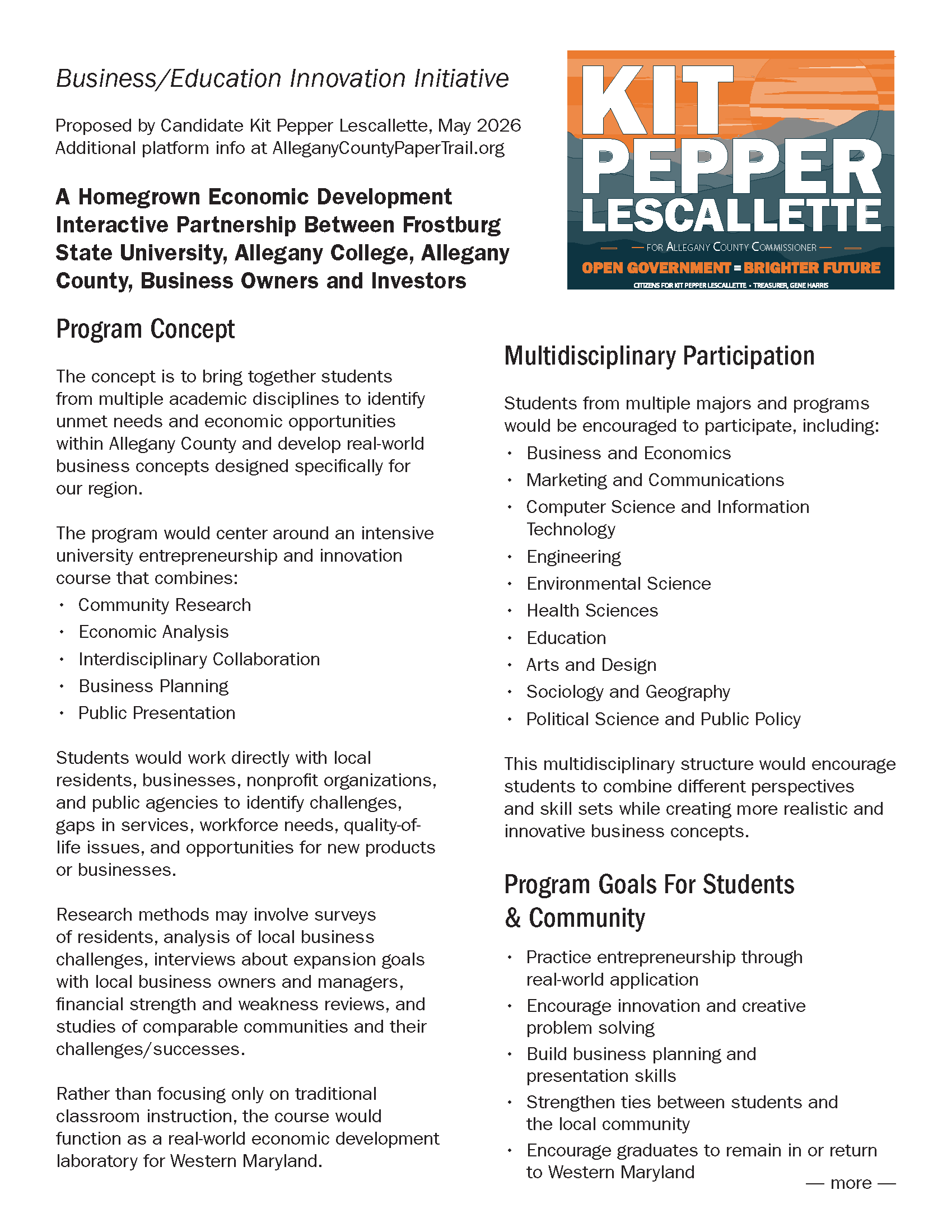
The proposed program would bring students from multiple academic disciplines together to identify unmet needs and economic opportunities in Allegany County. Rather than focusing only on traditional classroom instruction, the course would help students develop real-world business concepts designed specifically for the region.
Students would work directly with residents, businesses, nonprofit organizations and public agencies to identify gaps in services, workforce needs, quality-of-life concerns and possibilities for new products or businesses.
Research could include surveys of residents, interviews with business owners and managers about expansion goals, reviews of financial strengths and weaknesses, and studies of comparable communities.
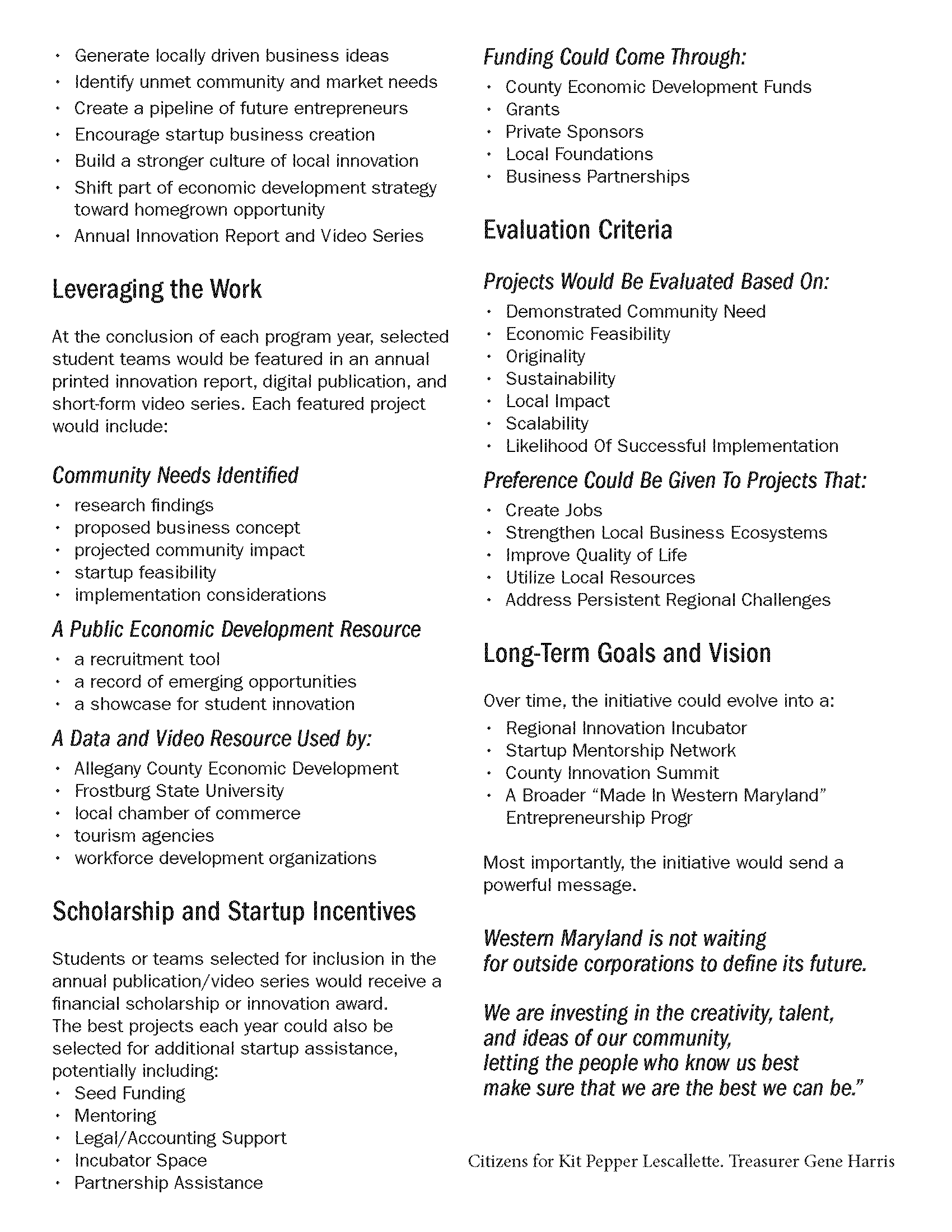
An intensive entrepreneurship and innovation course would combine community research, economic analysis, interdisciplinary collaboration, business planning and public presentation. Selected student teams would be featured in an annual printed innovation report, digital publication and short-form video series documenting community needs, proposed business concepts and potential local impact. The material could also help economic development and workforce organizations identify emerging opportunities.
Projects would be assessed for demonstrated community need, economic feasibility, originality, sustainability, local impact, scalability and likelihood of successful implementation. Preference could go to ideas that create jobs, strengthen local businesses, improve quality of life, use local resources or address persistent regional challenges.
Working across disciplines
Kit's proposal would encourage students from a wide range of majors to work together. Combining business, technology, science, design and public-policy perspectives could help teams create more realistic and innovative business concepts.
Goals for students and the community
The goal is more than an academic exercise. The proposal connects hands-on learning with stronger community relationships and a reason for graduates to see Western Maryland as a place to build their futures.
Students would practice entrepreneurship through real-world application, develop business plans, present their ideas and build creative problem-solving skills.
By researching challenges with residents, employers, nonprofit groups and public agencies, students would build stronger ties with the community while examining opportunities local businesses and neighborhoods have identified.
Identifying opportunities for new businesses could give graduates more reasons to remain in or return to Western Maryland. Encouraging locally driven startups could also build a pipeline of future entrepreneurs and make homegrown innovation a larger part of Allegany County's economic development strategy.
Scholarships and startup incentives
The initiative would offer ways for students to take promising projects beyond the classroom. Kit proposes financial scholarships or innovation awards for student teams selected for the annual publication, with additional assistance available to the best projects each year.
Students or teams featured in the annual innovation report and video series would receive a scholarship or innovation award.
Promising projects could receive seed funding, mentoring, legal or accounting support, incubator space and help forming business partnerships.
The program could seek support from county economic development funds, grants, private sponsors, local foundations and business partnerships.
Supporting documents
Review the original two-page Business/Education Innovation Initiative, proposed in May 2026. Select either page to open the full image.